
Just like donors, volunteers and staff members are a driving force behind nonprofit organizations. Without people giving their time and energy to support your cause, you probably wouldn’t get much done. One way to engage and show appreciation for these supporters is by offering them continuing education opportunities.
More specifically, let’s focus on a new trend in training and education that’s revolutionizing the way nonprofit constituents learn: microcredentials. Whether you want to create virtual training materials specific to your organization or provide access to microcredential courses, helping your supporters build on their existing skills shows that you value them.
With microcredentials, your volunteers and staff gain a deep knowledge of specific skills, expanding what your nonprofit can do. In this guide to the rise of microcredentials, we’ll answer the following questions about these credentials:
- What is a microcredential?
- What's the history of microcredentials?
- Why should nonprofits invest in microcredentials?

Because the industry is relatively young, the concept of a microcredential might be totally new to you. This rapidly growing type of skills-based course is just getting started within the instructional design field, and it is exciting to see where these credentials can take employees and their businesses. Let’s get started.
What is a microcredential?
Microcredential courses are different from traditional online courses or college classes. Microcredentials are short courses learners take to develop skills that are specific to their career or field. These learners can be anyone—students, employees of a for-profit business, or nonprofit organization members—and courses usually grant the learner a badge to display on sites like LinkedIn.
Since the microcredential industry is rapidly growing, there are countless types of microcredentials offered. To make the most of these opportunities, learners can stack microcredentials on top of each other—meaning they can build an impressive portfolio of credentials in different skills.
As this niche in the instructional design industry grows and becomes more ubiquitous, more learners and organizations will take advantage of microcredentials.
Microcredentials Timeline
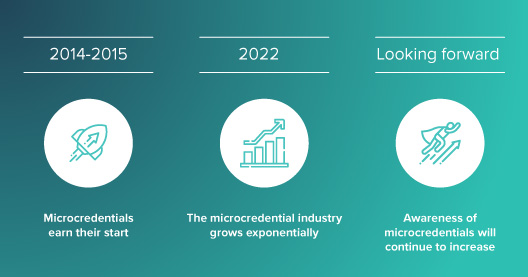
How did microcredentials get their start?
According to Skypack’s article on top instructional design trends, microcredentials are one of the youngest, fastest-growing forms of learning.
These courses were created as the solution to a problem many organizations faced. Businesses and nonprofits alike were searching for short, industry-specific courses that their employees could take to learn and develop the skills needed for their roles. Thus, microcredentials were born.
These certifications were designed to fulfill any of the reasons employees might need additional training. Whether employees or volunteers need to fill in gaps in their core education, update their skills and knowledge, or add value to what they bring to the table, there is probably a microcredential course to help them. These courses can even fulfill legally required training in fields like medicine.
What is the microcredential landscape like now?
The boom in microcredential courses hasn’t slowed down. In fact, the pandemic encouraged growth due to uncertainty about jobs and high demand for increased skillsets among new hires. While the job market isn’t in the same place it was at the onset of COVID-19 restrictions, the increased awareness of microcredentials had a lasting impact.
From developing soft skills to mastering data analysis, there are microcredentials for just about any field or skill. Because microcredentials are expanding into new industries and becoming more established, educational institutions around the globe are beginning to devise a standardized method for evaluating microcredentials. While existing standards are subject to change as the industry develops, the future for these credentials in academic spaces looks promising.
If the microcredentials relevant to your nonprofit’s mission haven’t been recognized by educational or government institutions, don’t worry. While authentication or approval from these institutions is nice to have, you shouldn’t wait on it to choose a microcredential course for your organization. These courses are a powerful way to boost skills and knowledge bases for nonprofit organizations regardless of if they are officially recognized.
What does the future of microcredentials look like?
As the instructional design landscape evolves, microcredentials will also develop and become more refined.
While there is no way to predict exactly what is in store for microcredentials, the industry looks promising. Following current trajectories, widespread awareness of microcredentials will continue to expand. With this increased awareness, more businesses, nonprofits, and individuals will acquire, or even require, these credentials.
As accessibility to microcredentials continues to expand, nonprofits could unlock new knowledge about important pathways to success by training with microcredentials tailored to their field. From learning about strategies to increase donor retention to discovering how to boost brand awareness, there are plenty of ways microcredentials can benefit nonprofits.
Why should nonprofits invest in microcredentials?
Just like any other industry, nonprofits benefit from expanding their employees’ abilities. However, the nonprofit sector has the potential to grow in unique ways by investing in its volunteers and staff.
Not only can you show your supporters how much you appreciate them by helping them cultivate new skills, but you can also build specialized departments and upgrade your marketing capabilities.
Grow your volunteer base and improve volunteer management.
Balancing your existing volunteer base with volunteer management can be tricky—especially if you have an influx of new volunteers. While gaining new volunteers is exciting, Double the Donation’s guide to volunteer management highlights the importance of high-quality training and onboarding for volunteers. With microcredentials, you can train volunteers in the areas that are relevant to the jobs they’ll perform within your organization.
Build new programs.
If you’ve ever looked into hiring on a new team to build out a program or department in your organization, you know that it is much more expensive than training existing staff to do these jobs. However, training staff to take on jobs like creating a development department can be challenging if no one on your team has experience in the area. This is where microcredentials come in handy.
Let’s say you want to create a new department within your nonprofit to focus on publicity. While you might not have any team member with extensive experience in running a publicity department, you can find microcredentials that cover everything your staff needs to know. The material taught in the microcredentials provides them with the skills and knowledge to take on jobs that are new to them and your entire organization.
Expand fundraising efforts.
Fundraising, an important key to your success as a nonprofit organization, can be challenging if your organization has a small team, donor pool, and budget.
Microcredentials can help you expand your horizons to fundraising opportunities you may not have had access to before. By building on the skills at your disposal through training your staff and volunteers with microcredentials, you can empower supporters to plan and launch innovative fundraisers.
Say your organization rarely launches fundraisers because your budget makes it difficult to host events. Alternative options like a social media-based fundraiser may seem hard to pull off if your team doesn’t have experience in social media marketing. However, a microcredential course about how to promote an organization on social media could give your staff the skills they need to garner lots of community support on this fundraiser.
Stay up-to-date.
As technology develops, your nonprofit’s skills and knowledge of tech should evolve too. Knowing how to use cutting-edge technology relevant to your industry can save you time, energy, and even money. Periodically investing in microcredentials that update your staff on the newest forms of technology in your slice of the nonprofit sector ensures your organization is working with the best, most current forms of technology.
Improve marketing efforts.
Investing in microcredentials can improve brand awareness, grow your supporter base, and boost revenue from fundraising events. Learning skills like how to track social media analytics or graphic design basics could be the missing piece you need to accomplish these goals. By teaching your staff more about marketing, you will reap the rewards of a top-tier marketing strategy.
Before choosing or creating a course, identify areas you think may need improvement. Then research microcredentials that can help meet your needs. To get started, look into courses about social media marketing, developing your storytelling, event planning, and managing your marketing budget.
Microcredentials and other instructional design services are one of the best ways to show your volunteers and staff members that you value what they have to offer. These courses are tailored to unique skill sets and are short enough for busy nonprofit professionals to complete. Not only can your organization invest in its supporters with these courses, but it can also boost its offerings with new programs and improved marketing that wouldn’t be possible without microcredentials.
______________________________________
Austin Bates, Director of Operations & Instructional Design, Skyepack
Born and raised in Texas, Austin learned at an early age the importance of dedication to a craft. During his Masters pursuit at Texas A&M University in Educational Technology, Austin began to question "Why not create better ways to teach in the online environment?" Skyepack soon became his catalyst for this new paradigm in online instruction. He is valued for his abilities to plan course designs, implement powerful teaching technology, and execute daily production assignments. In his spare time, Austin enjoys biking, watching football, and making every minute count.

 Donations
 Events
 Petitions
 Forms
Forms Shop
Shop Directories